
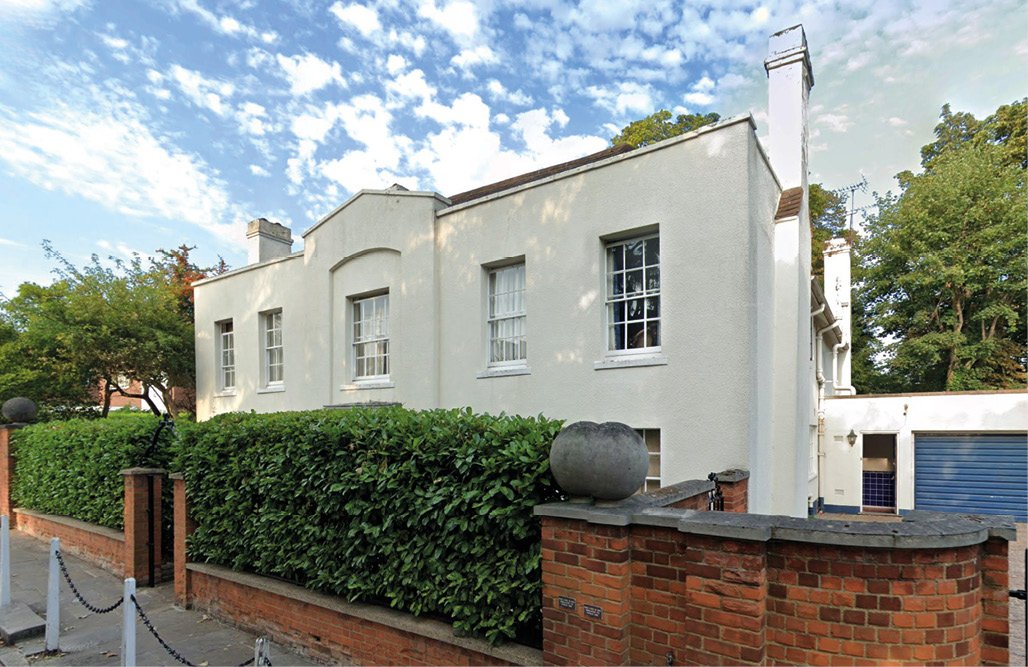
At the Woodford Historical Society’s February meeting, Jef Page will be exploring the origins of Redbridge street names, including Nutter Lane, home to one of the oldest houses in Wanstead
In 1653, Ilford stretched barely 100 yards along the High Road with just 53 houses, and Wanstead and Woodford probably had even fewer. This was, of course, because all the land was farmland, meadows and woods, with very few proper roads. For my talk this month, there are now many streets to choose from. I will start the talk with Ilford, then move on to Gants Hill (the derivation of its name), Barkingside (the cigarette estate), Wanstead and finish with Woodford.
Wanstead has a group of streets with connections to the former Wanstead House and the family names associated with it. The palace existed between 1715 and 1824. It was built by Sir Richard Child (1680–1750). George I ascended the throne in 1714 and granted Child the Irish title of Castlemaine, Kerry in 1718, so Child and his family were naturally loyal to the Crown. Road names with marriage connections include Draycot, Seagry, Mornington, Wellesley and Wellington. There’s no road named for Child (nor his wife Dorothy, née Glynne), but Tylney Road is south of Wanstead Flats. Catherine Tylney Long, eldest daughter of Sir James Tylney Long of Draycot, Wiltshire, married William Wellesley-Pole in 1812. He was the nephew of Wellington, and the Earl of Mornington was Wellington’s father. Catherine inherited the Wanstead House estate and was wealthy beyond words. She and ‘Wicked’ William bankrupted the family; the court’s judgement was that, in 1825, the house was to be “erased from the face of the earth” and so erase memory of the shame.
In 1880, the Cowley family owned large tracts of land and sold 184 acres of Wanstead Park to the Corporation of London for preservation as part of Epping Forest, and the rest was sold in 1920 to Wanstead Sports Grounds Ltd.
Nelson, Rodney and Victory roads and Trafalgar Place are close to Snaresbrook and Hermon Hill. Admiral George Rodney was a famous admiral when Britain ruled the waves. Admiral Lord Nelson won the Battle of Trafalgar, leading his famous ship HMS Victory to victory in 1805, though it cost him his life. No doubt residents were pleased to have these names selected and extol those heroes.
And, of course, we can’t ignore Nutter Lane. Originally George Lane, it was renamed Nutter Lane in 1934 following the construction of the Eastern Avenue. Richard Nutter was churchwarden of Christ Church (1853–1861) and lived with his daughters Mary, Gertrude and Jessie, who were great benefactors to Wanstead; in 1921, they gave the five-acre field opposite their house to the people of Wanstead for recreation and leisure. The sisters lived on the road until 1926 in a house named Applegarth, which is thought to have been built around 1710, making it one of the oldest houses in Wanstead.
Jef’s presentation will take place at All Saints’ Church hall in Woodford Wells on 12 February from 2.30pm (visitors: £5). For more information, visit wnstd.com/wdhs