One writer, one Interrail pass and a wildly over-ambitious, 37-stop journey to test railway accessibility in Europe. Wanstead-based travel writer Carole Edrich presents the fifth instalment of her Big Rail Story
Brussels South Station is Zuid in Dutch. You’d think it would be Sud in French. That would be way too easy. Instead, it’s called Midi. After years in Brussels, I’m no longer confused by this. I like to think… Ypres (which is Ieper in Dutch) is not confusing at all.
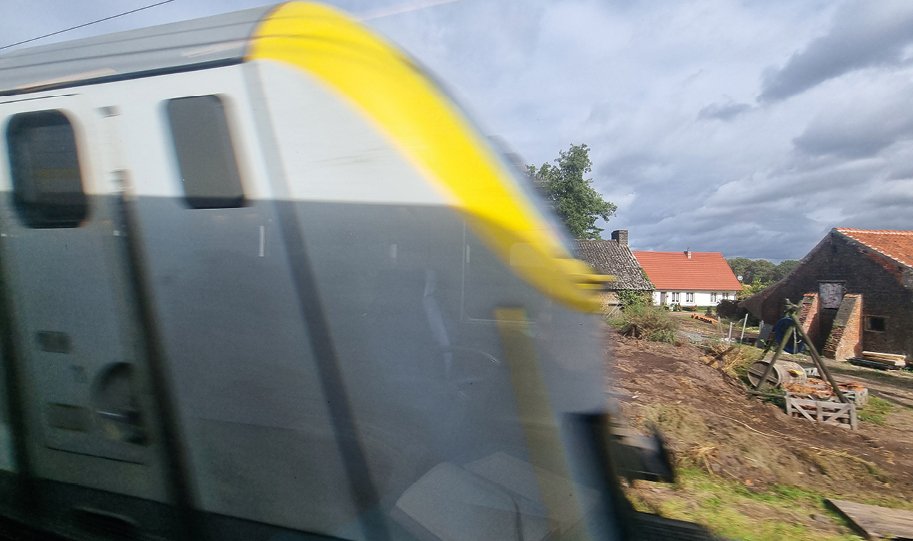
Somehow, I’m on an earlier-than-planned train to Gent St Pierre, watching the landscape flatten into fields, evenly distributed farms, woods and pools or ponds. They look restful now, although many could be bomb craters caused by the Allies in World War II, which these days is seriously sobering.
The train stops at Denderleeuw, which my slightly dodgy Dutch translates poetically. I recognise leeuw as lion, dender as teeth, think of dandelions flowering and imagine the beautiful town of Denderleeuw blossoming ever outwards. I wonder at the etymology and look it up. It turns out that dender is ancient Celtic for a roaring or turbulent river, and leeuw medieval Germanic for a burial mound. Proof that my dodgy Dutch can’t be much dodgier comes when I realise that dender doesn’t mean teeth at all. The burial ground has been long since absorbed, and the town is more commuter belt than country belle. The imaginatively named River Dender is nowadays calm and heavily managed, and the town’s heraldic adoption of a lion (I got that bit right, kinda) was more romantic than historical. Place name as palimpsest. Who’d have thought!
Leaving the town-with-a-name-that-records-a-wildness-that-has-since-been-erased, we travel under a beautiful wooden bridge at Welle. Welle means exactly what you’d think, if you heard it: well. Made entirely of tropical Azobe hardwood by the Dutch timber specialist Wijma Kampen, the bridge is a pedestrian gateway to the 65 hectare De Wellemeersen flood plain nature reserve. Wood was used instead of conventional materials after locals objected. This hardwood needed no additional treatment, cost roughly a third of a conventional bridge and will last a theoretical 100-odd years. You read that right; 65 hectares of Flemish wetland have been protected by transporting wood from a vulnerable tree species across continents to satisfy a nature conservation objection. And yes, by the Dutch, who were trading Gabonese hardwoods in the 1590s and are still doing so four centuries later. Unlike my Dutch, the irony holds up.
On we go to Gent-Sint-Pieters (hah). I’ve made good time and am early, so have a short wander before taking my connection to Ypres which – this time – I find with ease. Or so I think. Somehow, I arrive much later than planned. No wonder the ticket checker looked at me strangely. I was on the cheaper, slow train. Genius? Me? Well… I’m here now. And discover that the locals call it Yper.
For relevant links to the places, to read more of Carole’s work or to listen to her podcast, visit wnstd.com/edrich