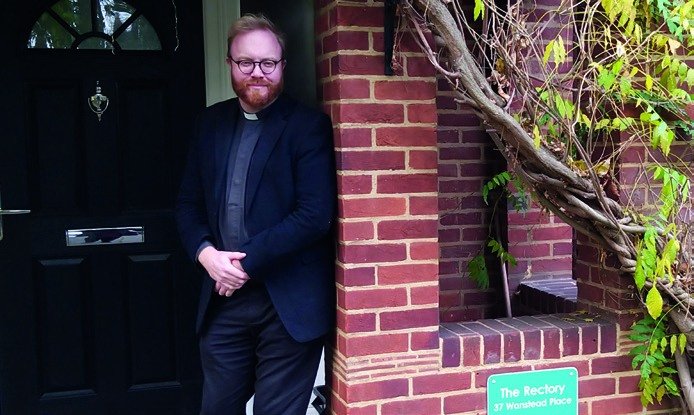
In the 16th of a series of articles, Revd James Gilder of Wanstead Parish finds that his love of puzzles leads to a deeper question: what does it really mean to be wise?
My wife is a journalist, and as part of her job, she enjoys digital subscriptions to the various daily papers, the fascination of which for me lies largely in the puzzle pages. We have a distinct puzzle routine: the 16-worder in The New York Times, followed by a slew of word-based ones from The Mail and then the Picle from The Times. And lest those puzzles seem a bit too right-wing, we even it up with the devilishly difficult Guardian quiz on a Saturday morning, at which we routinely score less than a third.
To the uninitiated, these puzzles may seem inconsequential, boring even. Yet, it has somehow become a matter of serious concern for us if they have not been completed, and in the right order, too.
When I was a child, I used to imagine people who could complete a cryptic crossword were extremely wise. Actually, maybe I still do! But in truth, I have found that wisdom and ‘cleverness’ don’t always go hand in hand. Elon Musk is undoubtedly clever, but I’m not sure I would count him as being wise. Was it wise of the super-intelligent Professor Hannah Fry to decide to be recruited as a ‘traitor’? (I’m writing this before the end of the series, so, you tell me). In truth, wisdom is a quality difficult to define. Many set great store on the ‘university of life’, and certainly experience has something to do with it. Yet, not all old people are wise – nor young people, fools.
We all benefit from wisdom in society. The Book of Proverbs says wisdom’s value is greater than gold or silver, and that true wisdom brings happiness. Probably the second-most genuinely wise person I have ever had the honour of knowing is former Archbishop of Canterbury Rowan Williams, one of those polymaths so clever yet also extremely humble; he always seems to give the person he’s listening to the impression that they are far more interesting than him, when often I would imagine it is really the other way round. However, the wisest (and kindest) person I ever knew was Brenda, a family friend who brought up three children on her own in the 1960s, in poverty, after her husband was run over whilst doing his job mending the roads.
If I had to define wisdom, I would say it is not the art of being clever at all. In actual fact, it is the art of being humble. Recognising where we have (and the world has) gone wrong and learning from it. Seeing others not as a threat but as equals to be encouraged and built up. I’m sure there have been such inspirationally wise people in your life, as there have in mine. Wisdom and humility are in short supply in the public square; they are qualities that rarely make the news, but which do make for better people and a better world. Let’s give thanks for the wise people who have helped us. And if anyone knows the answer to today’s Picle, please don’t tell me before 8.30pm!
MORE INFORMATION
To contact Reverend James Gilder, email office@parishofwanstead.org