
featured

Features

Now’s your turn

WVD-MAR-2026-x

As local election day approaches, Calvin Bailey MP urges residents to ensure they turn out to vote and encourages us all to be more engaged with local politics

On 7 May 2026, Wanstead will join the rest of London in heading to the polls to vote in the local government elections. Except many of us won’t. Local council elections have notoriously low turnout: only 45% of the Wanstead Park ward electorate voted in the 2022 local elections, with Wanstead Village voters seemingly less engaged with a 43% turnout (although these figures were higher than many of the other wards across Redbridge). This is all despite the fact our councils have a huge impact on our everyday lives and our community.  

As an MP, I know first-hand that local councillors often have a far greater ability to influence the day-to-day lives of constituents than I do. Your local council is responsible not only for waste collection and planning applications, but also for local education, social services, social housing, traffic management, environmental health and the provision of cultural services, amongst a whole host of other things.

Your local councillors represent the voice of your community when deciding how these services should be run. Councillors act as the link between the public and the council they are elected to serve. Despite this, many people don’t appreciate the enormous impact their local councillors can have on the quality of life in their community, and low voter turnout likely stems from a lack of awareness about the responsibilities of local government.

As with MPs, councillors are usually members of a political party, though some may choose not to belong to any party and are called independents. Redbridge is divided into 22 wards with three elected councillors for 19 wards (including Wanstead Village) and two councillors for three wards (including Wanstead Park), making 63 councillors in total.

Local councils across the country face significant financial pressures, limiting their ability to operate effectively. Outer London boroughs such as Redbridge have experienced pressures relating to population growth, housing patterns and demand for service. Despite these constraints, councils must continue to deliver vital public services, manage local infrastructure and continue to help shape and structure our communities.

No council is perfect, and that’s partly because far too many people disengage from local politics. If we want better local government policy, services and representation, we must take part in improving it. We can’t watch from the sidelines; we must use our vote. So, if you are not already on the electoral register, please register. The deadline to register for the May local elections is 11.59pm on 20 April, so don’t leave it until the last minute!


You can register to vote if you’re a British citizen or an Irish citizen. For more information, visit wnstd.com/register

News

Public meeting to explore options for Evergreen Field hoardings

WVD-NOV-2025-eg1

A public meeting will take place this month to discuss plans for an art project to revamp the hoardings surrounding the Evergreen Field construction site.

“The High Street hoardings could offer a canvas to reflect Wanstead’s character and creativity throughout the construction period. I’ve had some really good traction for the idea and would like to take this forward,” said local resident Bronagh Byrne, who is coordinating the initiative.

The meeting will take place on 21 March from 10.30am to 12.30pm at Christ Church.

Call 07906 541 789

News

Threads of empowerment: family embroidery workshop

WVD-MAR-2026-emb

An embroidery workshop inspired by women who have sparked change will take place at Wanstead Library as part of Women’s History Month celebrations.

“Learn about influential women and draw inspiration from their words, stories and impact. You’ll be guided through simple embroidery techniques to create your own embroidered hoop featuring empowering quotes or original designs,” said a spokesperson. The family-friendly workshop will take place from 1.30pm on 31 March (£3 per embroidery set).

Visit wnstd.com/threads

News

New website celebrates Wanstead’s iconic Shrubbery building

WVD-MAR-2026-shrub

A website has been launched to celebrate the architectural significance of The Shrubbery, an iconic Grade II listed residential building in Wanstead.

“The website will be a place to learn more about the building’s history, its design and the story behind it, as well as to keep the local community informed as restoration progresses,” said residents and directors Rohini Wahi and Scott Bartle.

Built in the 1930s, The Shrubbery is located on Grosvenor Road, just behind Wanstead High Street.

Visit theshrubberye11.co.uk

News

Free fixes and fashion swaps at Wanstead Repair Café

WVD-MAR-2026-swap

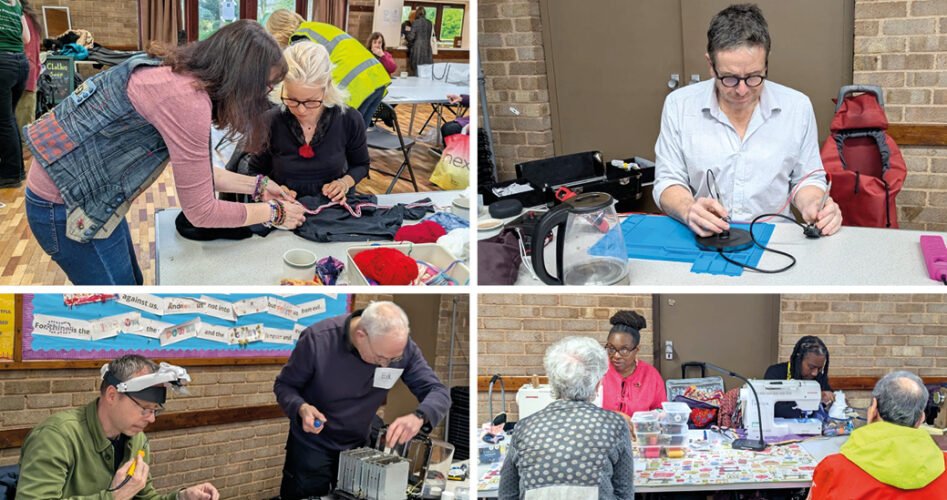
The next Wanstead Repair Café will take place on 7 March and, for the first time, will feature a clothes swap initiative.

“Bring along your pre-loved clothes to exchange for something new to you. Plus, as usual, you can bring along electronic items for repair, as well as any clothes and jewellery that need mending. MOT for bicycles will also be available to get them ready for the spring. All these services are absolutely free!” said a spokesperson.

The event will take place in Christ Church hall from 10.30am to 1pm.

Visit wnstd.com/repaircafe

News

Plans to reinstate 40 missing names on Wanstead War Memorial

WVD-MAR-2026-war©Geoff Wilkinson

As fundraising continues for the restoration of the Wanstead War Memorial, it has emerged that the names of a number of fallen servicemen are missing from the landmark.

“When the memorial was previously restored after the Second World War, it seems some 40 names were omitted from the new stones because the originals had become so worn they were illegible,” said Revd James Gilder.

A local historian has since uncovered all the missing names, with the memorial to be rededicated to include everyone from Wanstead who was originally commemorated.

“The extra engraving required means applying for planning permission and that, plus the process of adding the names themselves, comes at a significant extra cost. But I feel we must right the wrong that was caused in allowing those names to be forgotten. So, we press on with fundraising.”

More than £6,000 has been raised so far.

Visit wnstd.com/wwm or call 020 8530 8743

Features

Dear Sadiq…

WVD-AUG-2025-bus

Wanstead resident and journalist Donna Mizzi writes an open letter to Sir Sadiq Khan, the Mayor of London and chairman of TfL, on behalf of local W14 bus users

Dear Sir Sadiq Khan,

You have recently answered a London Assembly member’s question on the hourly W14 buses by stating the number of users is not high enough to justify a more frequent service. Local residents want to make it clear that it is TfL’s bus reorganisation that has directly reduced its usability. It is too infrequent, ridiculously unreliable and no longer goes where passengers need to reach, even terminating short of Whipps Cross Hospital.

From the date the new W14 bus was imposed in 2024, passenger figures plunged dramatically from about 1,800 to 300 a day. No one knew when the reduced hourly bus was due or where it would actually stop. And it still continues to be much of a mystery bus today. It’s usually late, sometimes early and frequently doesn’t arrive at all.

Yet the W14 is the sole bus service and only public transport accessible for hundreds of Wanstead and South Woodford households on the huge Nightingale Estate, and for further hundreds of flats and 60 retirement units by Snaresbrook Road. Most of those homes are beyond acceptable walking distances to essential services or other transport, particularly for the elderly, disabled or mums with young children. For those reasons, a bus service has run there for 36 years.

Elderly and disabled people cannot stand out in the freezing cold or in other extreme weather waiting for a bus which may or may not arrive. Residents, including the elderly, have frequently become ‘stranded’ when trying to get back home, waiting up to three hours for the next W14 to arrive. TfL has said for 17 months it has been working on W14’s reliability, but as you admit, it has still not met the minimum standard required.

When presented with TfL’s own W14 figures, you have stated: “none of the current routes are directly comparable with the old route numbers prior to the changes.” You say there are too many empty seats at present, exaggerated by TfL imposing unwanted oversized buses down these narrow residential roads. Meanwhile, hordes of children no longer contribute to daily passenger numbers because the W14 service does not coincide with school times. Pupils are also badly affected.

Here are other startling figures. An Equality Impact Assessment reveals the W14 route contains the highest percentage of elderly (41%) and disabled people (5%) using it out of all the local W-bus services. Therefore, TfL has hit the most vulnerable residents. The harmful impact has been massive, including despair, social isolation, inability to get to vital health appointments or even visit a pharmacy or food shops. Residents who cannot afford to keep the heating on are unable to reach a warm space. Carers and relatives also have more trouble reaching those who need support. These vulnerable groups are also less likely to have smartphones or computers, though the W14 service updates often don’t appear, anyway.

TfL’s positive spins on the overall W-bus services do not reveal the full picture. For instance, the W12 now covers more miles but also contributes to traffic jams in ultra-congested Leytonstone, so it often takes frail passengers 50 minutes to travel from Snaresbrook to Whipps Cross Hospital when their journey previously took 10 minutes.

W-bus problems have been dire enough to create an ITN News report, an MP’s petition presented to Parliament, demonstrations, public meetings, a 5,400-signature petition and direct questions to you in the London Assembly. Meanwhile, families have gone back to using cars or even struggle to buy a vehicle or order taxis. Or they avoid going out. Parents interrupt their work to run their children to school, clocking up double the road miles that taking a W14 would entail. Commuters’ travel time is extended. Individuals fear walking long distances along dark, quiet roads back to their homes. Others struggle with heavy groceries. Such bad services are not good for individuals, families, the health service nor the economy.

One of your main aims, you say, is to persuade Londoners to give up driving and use public transport. If so, increasing the W14’s frequency would be a priority.

Apart from the needs for greater frequency and a stop within Whipps Cross Hospital’s grounds (backed by its management), the other main W14 issues are:

The southbound W14 has been amended to stop near Wanstead Tube station. Passengers with mobility problems also need to get back from there; the present baffling W14 northbound stop is a third of a mile away.

The new W14 no longer stops by George Lane’s main shopping area and big supermarkets, making even weekly food shopping difficult. Changing buses with a heavy shopping trolley is not a sensible TfL suggestion.

TfL has failed to grasp the situation for 18 months. Local residents would love to hear some encouraging news from you as soon as possible.

Yours sincerely,
Donna Mizzi
(reply to editor@wnstd.com)


Written questions were submitted by the Deputy Chair of the London Assembly Transport Committee, Caroline Russell, who called a Wanstead public meeting on the bus problems last June. She has agreed to deliver this letter to Sadiq Khan.

Original written questions and answers between Caroline Russell and Sadiq Khan

Changes to bus routes in Wanstead and pupils getting to school
Question No: 2025/4565

Caroline Russell:
Thank you for your answer to my question 2025/3980, in which you said: “Recent data shows that the onboard load on route W14 at the busiest point is 18 passengers; this compares to an hourly capacity of 55.” A constituent (ie me who managed to get TfL’s figures) has contacted me saying: “Just before the date of the changeover there were 1,639 daily boarders on the W12 and about 150 on the 549 bus. Straight after the changeover there were a total of 293 boarders on the W14 (the renamed W12 route, which also newly absorbed the closed down 549 route). That’s roughly 1,800 passengers reduced to 300.” Do you recognise this reduction in the number of passengers using these buses?

The Mayor:
Last updated: 23 December 2025 (Donna didn’t get sent a copy of this answer until the end of January).
The re-structuring of the W-route network saw the W12 broadly take over the northern end of the old W14, and the W13 take over the southern end of the old W14. Route 549 was then extended and covered a section of the old W12 and renamed W14. Therefore, the current W14 is more similar to the old 549 rather than the old W12, but essentially none of the current routes are directly comparable with the old route numbers prior to the changes.
Transport for London (TfL) published a review of the W-routes network in April 2025, which can be found via this link: tfl.gov.uk/cdn/static/cms/documents/review-of-the-w-route-restructuring.pdf. This shows how the bus routes changed and found the combined usage on the routes post-restructuring had grown by 12 per cent.


Changes to bus routes in Wanstead and pupils getting to school
Question No: 2025/3980

Caroline Russell:
Following the changes to the W12 and W14 bus services in Wanstead, young people living on the Nightingale Estate have an unreliable hourly service (W14) that does not allow them to get to school on time while the alternative service (W12) is often full and can’t take them. Could you make the W14 service half-hourly instead of hourly to help young people get to school on time?
Changes to bus routes in Wanstead and pupils getting to school

The Mayor:
Last updated: 25 November 2025
Transport for London (TfL) continuously monitors and reviews the bus network to ensure that capacity is well matched to demand. Recent data shows that the onboard load on route W14 at the busiest point is 18 passengers; this compares to an hourly capacity of 55. This is not high enough to justify an increase in the service frequency, and thus no further changes are proposed.
Recently, the on-time performance on both routes W12 and W14 have not met the minimum standard required, with lost mileage due to traffic and mechanical issues higher than expected; this is likely the reason for any observed crowding. New vehicles were introduced on both routes during the summer, and this should improve service reliability. TfL will also continue to monitor performance and work closely with the operator to ensure there is an improvement in on-time running.

News

Council investigates tree concerns at Waterworks Cottage

WVD-MAR-2026-wc3After
Before

Redbridge Council’s Planning Enforcement Team is investigating reports of potential unauthorised works involving protected trees at the Waterworks Cottage off the Eastern Avenue.

“Initial checks confirm the immediate site does not contain any trees covered by a Tree Preservation Order, nor is it located within a Conservation Area… However, there are protected trees in the surrounding area and the team is assessing whether any of these trees may have been affected by the works,” said a spokesperson.

News

Much-loved Snaresbrook goose killed on Woodford Road

WVD-MAR-2026-goose

A much-loved Egyptian Goose often seen in the Snaresbrook area has died after being hit by a car on Woodford Road.

“Dudley and his partner Doris were known to many in our community and often seen grazing by The Drive. Dudley suffered a badly broken leg and other injuries and passed away at the scene. Doris was very distressed. I laid him on a white blanket, ensuring she could see him to understand he was gone and did not wait for him or go searching for him,” said Gill Walker, a local waterbird rescue volunteer.

Features

Big Rail Story

WVD-FEB-2026-rail© Carole Edrich

One writer, one Interrail pass and a wildly over-ambitious, 37-stop journey to test railway accessibility in Europe. Wanstead-based travel writer Carole Edrich presents the second instalment of her Big Rail Story

Unless you’re in the Eurostar Business Lounge at St Pancras, waiting is a noisy, uncomfortable experience. Before the Thalys takeover, my points would have earned me access. Now that ‘frequent traveller’ benefit requires 70 trips in a year. That’s not frequent travel; it’s living on the train. The quiet corner I’ve waited in since then – the only quiet corner in the waiting area – is roped off. Elsewhere, there’s not even wall space to lean on. Proving overcrowding for an £80 article would need applications to seven different authorities. I give up.

They’ve told us they’re planning to turn Channel rail trips into a ‘turn up and go’ experience, where passengers can arrive ‘minutes before departure’ without crowding or excessive queues. A previous Eurostar CEO said it’s only reduced timetables that prevent daily queues as big as the ones at the Channel ports. The new EU Entry/Exit system needs 75 minutes, so ‘turn up and go’ feels as ambitious as Elmer Fudd catching that ‘wascally wabbit’ and Mr Magoo finding the right door. Hang on, I can’t find their feasibility study either – add Wile E Coyote catching the Road Runner on a Warner Bros or even Netflix screen.

Anyhow, at this point I realise my carefully planned minimal luggage (including prized UV flask and emergency sugar-free lemonade) is way too heavy. When the Paris train leaves, I finally score a seat and repack, shoving as much as I possibly can into my wheely bag while hoping I can manage the backpack all the way to my first overnight. ME (chronic fatigue) is such an unpredictable bummer, but I won’t give up. I browse through Stylist and see a gorgeous lime-green coat I don’t need, and Dior Capture Pro-Collagen Shot serum for fatigue that I do, but can’t afford. I give up.

I get talking to a man with Parkinson’s. With my Disability Review Magazine hat on, I ask what might make his trip easier. He says since stress makes things worse, more signage would help. Lack of help lifting big bags onto scanning machines when you’re disabled and your belt is in the x-ray tray is also a biggie. And he read there’d be enough to do while waiting for the train. Apart from musical chairs for seating and dodgems for refreshments, there is not. He and his wife take organised tours to minimise travel stresses. But Turin by rail entails a cross-city transfer in Paris, and that is famous for its stress. I don’t have the heart to say.

Here’s a hint. Get on Eurostar first if you want to keep your luggage on the floor nearby, or last to avoid the crush. Eurostar platforms aren’t announced until after trains are disembarked and cleaned, but you can work them out from the lifts the staff use 40 minutes before departure. Because I’m first in the queue, I get to put my luggage in one of the very few gaps between back-to-back seats. This isn’t rocket science; it’s hard-won ME management tactics. Genius? Me?


For relevant links to the places, to read more of Carole’s work or to listen to her podcast, visit wnstd.com/edrich

News

Ornamental Water lakebed mapping to assess capacity to hold water

WVD-FEB-2026-lake

The City of London Corporation has begun mapping the lakebed of Wanstead Park’s dried-out Ornamental Water.

“We will be conducting borehole surveys across the lakebed to assess the below-ground conditions. This will help us to assess the lakebed’s capacity to hold water… and guide future conservation efforts,” said a spokesperson.

The Environment Agency is currently considering an application to pump water into the lake from the River Roding, with a decision expected later this year.

News

Steel frame to support leaning Grotto ruins in Wanstead Park

WVD-FEB-2026-grotto2How the steel frame will look

Work is underway to install a steel frame to support the Grotto ruins in Wanstead Park.

“The top of the Grotto is leaning; we need to stabilise it to ensure it remains secure. The steel frame will have minimal impact on existing brickwork and can be beneficial for any future restoration work,” said a City of London Corporation spokesperson.

The pathway behind the 18th-century landmark will be closed until project completion at the end of March. “Due to ground conditions, we will not be able to open the path at weekends.”