
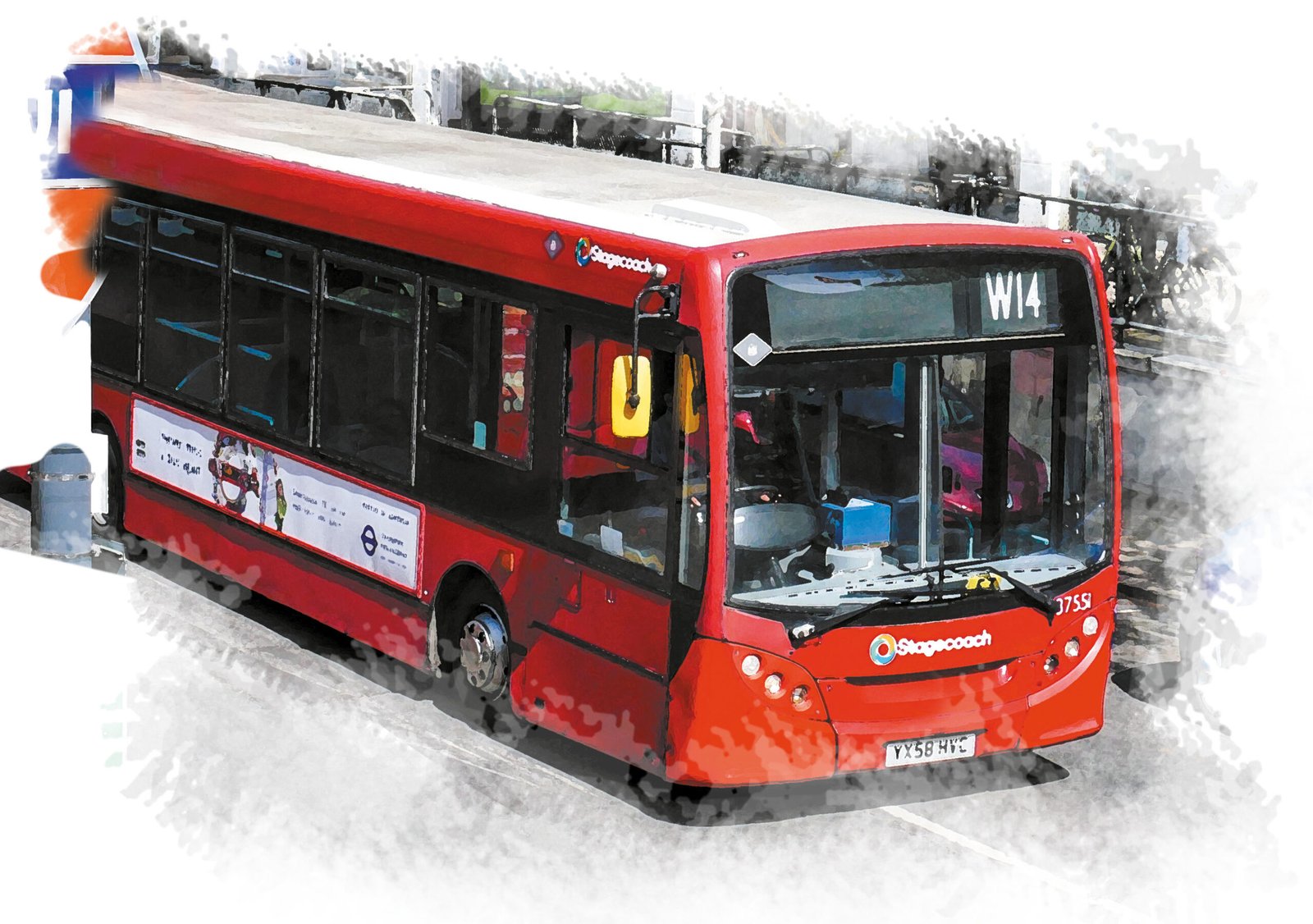
Wanstead resident and journalist Donna Mizzi writes an open letter to Sir Sadiq Khan, the Mayor of London and chairman of TfL, on behalf of local W14 bus users
Dear Sir Sadiq Khan,
You have recently answered a London Assembly member’s question on the hourly W14 buses by stating the number of users is not high enough to justify a more frequent service. Local residents want to make it clear that it is TfL’s bus reorganisation that has directly reduced its usability. It is too infrequent, ridiculously unreliable and no longer goes where passengers need to reach, even terminating short of Whipps Cross Hospital.
From the date the new W14 bus was imposed in 2024, passenger figures plunged dramatically from about 1,800 to 300 a day. No one knew when the reduced hourly bus was due or where it would actually stop. And it still continues to be much of a mystery bus today. It’s usually late, sometimes early and frequently doesn’t arrive at all.
Yet the W14 is the sole bus service and only public transport accessible for hundreds of Wanstead and South Woodford households on the huge Nightingale Estate, and for further hundreds of flats and 60 retirement units by Snaresbrook Road. Most of those homes are beyond acceptable walking distances to essential services or other transport, particularly for the elderly, disabled or mums with young children. For those reasons, a bus service has run there for 36 years.
Elderly and disabled people cannot stand out in the freezing cold or in other extreme weather waiting for a bus which may or may not arrive. Residents, including the elderly, have frequently become ‘stranded’ when trying to get back home, waiting up to three hours for the next W14 to arrive. TfL has said for 17 months it has been working on W14’s reliability, but as you admit, it has still not met the minimum standard required.
When presented with TfL’s own W14 figures, you have stated: “none of the current routes are directly comparable with the old route numbers prior to the changes.” You say there are too many empty seats at present, exaggerated by TfL imposing unwanted oversized buses down these narrow residential roads. Meanwhile, hordes of children no longer contribute to daily passenger numbers because the W14 service does not coincide with school times. Pupils are also badly affected.
Here are other startling figures. An Equality Impact Assessment reveals the W14 route contains the highest percentage of elderly (41%) and disabled people (5%) using it out of all the local W-bus services. Therefore, TfL has hit the most vulnerable residents. The harmful impact has been massive, including despair, social isolation, inability to get to vital health appointments or even visit a pharmacy or food shops. Residents who cannot afford to keep the heating on are unable to reach a warm space. Carers and relatives also have more trouble reaching those who need support. These vulnerable groups are also less likely to have smartphones or computers, though the W14 service updates often don’t appear, anyway.
TfL’s positive spins on the overall W-bus services do not reveal the full picture. For instance, the W12 now covers more miles but also contributes to traffic jams in ultra-congested Leytonstone, so it often takes frail passengers 50 minutes to travel from Snaresbrook to Whipps Cross Hospital when their journey previously took 10 minutes.
W-bus problems have been dire enough to create an ITN News report, an MP’s petition presented to Parliament, demonstrations, public meetings, a 5,400-signature petition and direct questions to you in the London Assembly. Meanwhile, families have gone back to using cars or even struggle to buy a vehicle or order taxis. Or they avoid going out. Parents interrupt their work to run their children to school, clocking up double the road miles that taking a W14 would entail. Commuters’ travel time is extended. Individuals fear walking long distances along dark, quiet roads back to their homes. Others struggle with heavy groceries. Such bad services are not good for individuals, families, the health service nor the economy.
One of your main aims, you say, is to persuade Londoners to give up driving and use public transport. If so, increasing the W14’s frequency would be a priority.
Apart from the needs for greater frequency and a stop within Whipps Cross Hospital’s grounds (backed by its management), the other main W14 issues are:
The southbound W14 has been amended to stop near Wanstead Tube station. Passengers with mobility problems also need to get back from there; the present baffling W14 northbound stop is a third of a mile away.
The new W14 no longer stops by George Lane’s main shopping area and big supermarkets, making even weekly food shopping difficult. Changing buses with a heavy shopping trolley is not a sensible TfL suggestion.
TfL has failed to grasp the situation for 18 months. Local residents would love to hear some encouraging news from you as soon as possible.
Yours sincerely,
Donna Mizzi (reply to editor@wnstd.com)
Written questions were submitted by the Deputy Chair of the London Assembly Transport Committee, Caroline Russell, who called a Wanstead public meeting on the bus problems last June. She has agreed to deliver this letter to Sadiq Khan.
Original written questions and answers between Caroline Russell and Sadiq Khan
Changes to bus routes in Wanstead and pupils getting to school
Question No: 2025/4565
Caroline Russell:
Thank you for your answer to my question 2025/3980, in which you said: “Recent data shows that the onboard load on route W14 at the busiest point is 18 passengers; this compares to an hourly capacity of 55.” A constituent (ie me who managed to get TfL’s figures) has contacted me saying: “Just before the date of the changeover there were 1,639 daily boarders on the W12 and about 150 on the 549 bus. Straight after the changeover there were a total of 293 boarders on the W14 (the renamed W12 route, which also newly absorbed the closed down 549 route). That’s roughly 1,800 passengers reduced to 300.” Do you recognise this reduction in the number of passengers using these buses?
The Mayor:
Last updated: 23 December 2025 (Donna didn’t get sent a copy of this answer until the end of January).
The re-structuring of the W-route network saw the W12 broadly take over the northern end of the old W14, and the W13 take over the southern end of the old W14. Route 549 was then extended and covered a section of the old W12 and renamed W14. Therefore, the current W14 is more similar to the old 549 rather than the old W12, but essentially none of the current routes are directly comparable with the old route numbers prior to the changes.
Transport for London (TfL) published a review of the W-routes network in April 2025, which can be found via this link: tfl.gov.uk/cdn/static/cms/documents/review-of-the-w-route-restructuring.pdf. This shows how the bus routes changed and found the combined usage on the routes post-restructuring had grown by 12 per cent.
Changes to bus routes in Wanstead and pupils getting to school
Question No: 2025/3980
Caroline Russell:
Following the changes to the W12 and W14 bus services in Wanstead, young people living on the Nightingale Estate have an unreliable hourly service (W14) that does not allow them to get to school on time while the alternative service (W12) is often full and can’t take them. Could you make the W14 service half-hourly instead of hourly to help young people get to school on time?
Changes to bus routes in Wanstead and pupils getting to school
The Mayor:
Last updated: 25 November 2025
Transport for London (TfL) continuously monitors and reviews the bus network to ensure that capacity is well matched to demand. Recent data shows that the onboard load on route W14 at the busiest point is 18 passengers; this compares to an hourly capacity of 55. This is not high enough to justify an increase in the service frequency, and thus no further changes are proposed.
Recently, the on-time performance on both routes W12 and W14 have not met the minimum standard required, with lost mileage due to traffic and mechanical issues higher than expected; this is likely the reason for any observed crowding. New vehicles were introduced on both routes during the summer, and this should improve service reliability. TfL will also continue to monitor performance and work closely with the operator to ensure there is an improvement in on-time running.